Have you ever heard a sermon that rubbed you the wrong way?
Maybe something the preacher said bothered you. Maybe you disagreed with the way he said it. Maybe you walked away thinking he was too harsh, too strong, or simply wrong.
I have.
And sometimes, after thinking about it, I have concluded that I really did disagree. Preachers are not infallible. We can misunderstand a passage, say something poorly, or fail to explain something as carefully as we should.
But sometimes the problem was not the sermon. Sometimes the truth had simply gotten too close. And that is much harder to admit.
When a sermon makes us uncomfortable, it is remarkably easy to begin framing our understanding of the sermon around our feelings.
– I felt attacked.
– That sounded unkind.
– I did not like the way he said what he said.
And before long, our reaction to the sermon becomes our interpretation of the sermon.
But feeling uncomfortable does not necessarily mean we have been treated unfairly. Sometimes conviction is uncomfortable. Sometimes correction is uncomfortable. Sometimes the Word of God confronts something in us that we would rather defend than examine.
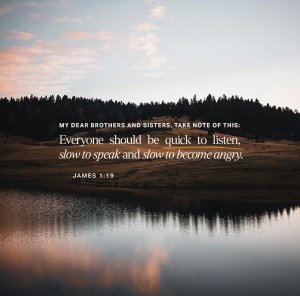
James writes: “Let every person be quick to hear, slow to speak, slow to anger.” – James 1.19
We often use those words as general advice for relationships and communication, and rightly so. But James is writing about our response to the Word of God. A few verses later, he tells us to “receive with meekness the implanted word.”
Perhaps we need to learn to listen to expositional preaching with expositional hearing.
That means we do not begin with, “How did that make me feel?”
We begin with:
– What did the preacher actually say?
– What was he trying to communicate?
– What does the text actually say?
– And why did this bother me so much?
We would do well to listen prayerfully before reacting quickly.
That does not mean every preacher is right. It does not mean we accept everything we hear without discernment. We should open our Bibles. We should examine the text. We should test what is taught.
But biblical discernment and personal defensiveness are not the same thing.
One wants to know whether the message is true.
The other wants to prove that my reaction was justified.
How we respond when the Word confronts us may reveal more about our hearts than we realize.
– Pride is quick to speak, quick to defend, and quick to assume the problem lies somewhere else.
– Humility is willing to listen again. Humility opens the Bible. Humility prays, “Lord, show me what is true, even if I do not like what I find.”
The next time a sermon rubs you the wrong way, do not be too quick to dismiss it. Listen to it again. Open your Bible. Pray. And ask whether the truth that unsettled you might be the truth you needed to hear.


I’ve been known to say that if the Lord (through the preaching) didn’t step on my toes, I didn’t feel like I’d been to church. A healthy dose of needed conviction and repentance does no harm.