Why We Sing What We Sing

Have you ever left Sunday morning worship thinking, “I just didn’t get much out of the singing today”?

Perhaps the songs weren’t familiar. Perhaps they weren’t your preferred style. Perhaps they simply didn’t resonate with you the way you hoped they would. I have.

Sometimes I’ve concluded that I simply preferred different songs. Churches don’t always make the same musical choices, and not every song will resonate with every believer in exactly the same way.

But sometimes the problem wasn’t the songs. Sometimes I just forgot what congregational singing was actually for. It’s very easy to evaluate worship by asking questions like:

Did I enjoy those songs?
– Did they move me emotionally?
– Did I connect with them?

Those aren’t unimportant questions, but perhaps they may not be the first questions.

The Apostle Paul gives us a different perspective in Colossians 3.16. He tells us that as God’s people sing, “the word of Christ” dwells richly among them. Their songs teach. They admonish. They encourage. They fill hearts and minds with truth.

That means congregational singing is doing far more than creating an emotional experience. God is using it to shape His people.

I’ve found myself increasingly grateful for faithful congregational singing. Not because every song has been my favorite, or because every arrangement has reflected my personal preferences, but because I’ve been reminded what God is doing through it.

Faithful congregational singing doesn’t simply accompany worship; it quietly helps shape the hearts of those who participate in it. Congregational singing is the weekly rehearsal of reality.

Every Sunday the church helps one another remember what the rest of the week conspires to make us forget:
God is still holy.
– Christ is still worthy.
– The gospel is still true.
– Our hope is still secure.

We are not teaching God these things. We are reminding our emotions of them.

The world spends six days pulling our attention in a thousand different directions. It quietly teaches us to measure life by our circumstances, our emotions, our successes, our disappointments, and our fears.
Then the Lord’s Day comes.

God gathers His people, and together they sing truths that gently reorient their hearts toward what is eternally true.

That also helps explain why the songs we sing matter. The question isn’t whether a song is old or new. Nor is it simply whether it is musically excellent or emotionally moving. The better question is this: Where is this song directing my attention?

Some songs primarily magnify the greatness, holiness, faithfulness, and worthiness of God. Others spend most of their time occupied with us – our feelings, our experiences, our commitments, and our responses.

To be sure, there is a proper place for singing about what God has done in our lives. Scripture itself does that often. But biblical worship has a remarkable way of lifting our eyes beyond ourselves to the One who is worthy of our praise.

The next time you gather with God’s people, don’t begin by asking, “Did I enjoy the singing?”

Rather ask: Did these songs help me see God more clearly?

Because perhaps the greatest gift of congregational singing isn’t that it simply gives expression to our hearts. It’s that, week after week, it gently teaches our hearts where they belong.

When a Sermon Rubs You the Wrong Way

Have you ever heard a sermon that rubbed you the wrong way?

Maybe something the preacher said bothered you. Maybe you disagreed with the way he said it. Maybe you walked away thinking he was too harsh, too strong, or simply wrong.
I have.

And sometimes, after thinking about it, I have concluded that I really did disagree. Preachers are not infallible. We can misunderstand a passage, say something poorly, or fail to explain something as carefully as we should.

But sometimes the problem was not the sermon. Sometimes the truth had simply gotten too close. And that is much harder to admit.

When a sermon makes us uncomfortable, it is remarkably easy to begin framing our understanding of the sermon around our feelings.
I felt attacked.
– That sounded unkind.
– I did not like the way he said what he said.

And before long, our reaction to the sermon becomes our interpretation of the sermon.

But feeling uncomfortable does not necessarily mean we have been treated unfairly. Sometimes conviction is uncomfortable. Sometimes correction is uncomfortable. Sometimes the Word of God confronts something in us that we would rather defend than examine.

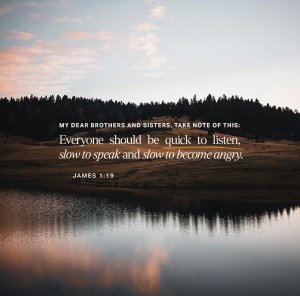
James writes: “Let every person be quick to hear, slow to speak, slow to anger.” – James 1.19

We often use those words as general advice for relationships and communication, and rightly so. But James is writing about our response to the Word of God. A few verses later, he tells us to “receive with meekness the implanted word.”

Perhaps we need to learn to listen to expositional preaching with expositional hearing.

That means we do not begin with, “How did that make me feel?”
We begin with:
– What did the preacher actually say?
– What was he trying to communicate?
– What does the text actually say?
– And why did this bother me so much?
We would do well to listen prayerfully before reacting quickly.

That does not mean every preacher is right. It does not mean we accept everything we hear without discernment. We should open our Bibles. We should examine the text. We should test what is taught.

But biblical discernment and personal defensiveness are not the same thing.
One wants to know whether the message is true.
The other wants to prove that my reaction was justified.

How we respond when the Word confronts us may reveal more about our hearts than we realize.
– Pride is quick to speak, quick to defend, and quick to assume the problem lies somewhere else.
– Humility is willing to listen again. Humility opens the Bible. Humility prays, “Lord, show me what is true, even if I do not like what I find.”

The next time a sermon rubs you the wrong way, do not be too quick to dismiss it. Listen to it again. Open your Bible. Pray. And ask whether the truth that unsettled you might be the truth you needed to hear.

The Model of Biblical Masculinity

In a culture confused about manhood, we do not need new definitions.

We need to look at Jesus.

He initiated our salvation at the cost of His life.

He led by serving.

He provides for His people.

He protects His church – even to the point of death.

Biblical masculinity is not aggression.

It is not passivity.

It is not selfish ambition.

It is sacrificial leadership, humble service, faithful provision, and courageous protection.

In other words, biblical masculinity looks like Jesus.

The deeper a man’s relationship with Christ, the more he becomes the man God created him to be.

“Husbands, love your wives, as Christ loved the church and gave himself up for her.” – Ephesians 5.25

Take the Step

Many believers spend their lives waiting for perfect certainty before they obey God.

But faith rarely works that way.

Faith acts.

Faith obeys.

Faith moves forward trusting that God will prove Himself faithful along the way.

Will we sometimes stumble?

Of course.

But it is better to take a stumbling step of faith than to remain frozen by fear.

God does not call His people to flawless performance.

He calls them to trusting obedience.

The servant who attempts much for God may occasionally fail.

The servant who attempts nothing never learns the faithfulness of God.

Faith grows when exercised.

So take the step.

Trust the Lord.

And leave the results in His hands.

“Without faith it is impossible to please Him.” – Hebrews 11.6

Spiritual drift is rarely a sudden decision.

Spiritual drift is rarely a sudden decision. It is usually a gradual neglect.

A neglected Bible becomes an occasional Bible.

An occasional prayer becomes a hurried prayer.

A hurried prayer becomes no prayer at all.
Worship becomes optional.

Convictions become preferences.
Sin becomes tolerated.

And before long, a person finds himself farther from God than he ever intended to be.

That is why Hebrews warns: “We must pay much closer attention to what we have heard, lest we drift away from it.” (Hebrews 2.1)

No sailor drifts toward the harbor. Drift always carries us away from our destination.

The Christian life requires intentionality. Not because God is reluctant to keep His people, but because God uses ordinary means – His Word, prayer, fellowship, worship, and obedience – to keep us close to Himself.

If you feel distant from the Lord today, don’t wait for a dramatic spiritual experience.

Open your Bible.

Pray.

Gather with God’s people.

Take the next step of obedience.

The way back is often found in the simple things we first neglected.

Guarding the Unity of the Church

“…eager to maintain the unity of the Spirit in the bond of peace.” – Ephesians 4:3

People leave churches for different reasons. Sometimes that happens in a healthy and God-honoring way. At other times, it does not. Most of the time, people do not leave all at once. They drift. Little by little, influences and opportunities begin to pull them away from the life and unity of the church.

Scripture calls us to think carefully about the nature of the church. God has not designed His people to live in isolation, nor to create parallel or competing expressions of church life. He gathers His people into visible, accountable communities that are shepherded by recognized leaders, shaped by His Word, and marked by unity.

Because of that, we should be thoughtful when invitations or opportunities arise, especially those that exist outside the life and accountability of a local church, or that begin to function as a parallel influence on our direction, doctrine, or spiritual growth. This can take many forms: independent gatherings, loosely connected Bible studies, online voices that begin to shape our thinking, or groups that function without clear shepherding or accountability.

Not every invitation is helpful. And not every gathering is wise to join.

Wisdom asks simple questions:
Is this drawing me closer to the life of my church, or subtly away from it?
– Is this reinforcing the teaching and leadership God has placed over me or competing with it?
– Is this strengthening unity or introducing confusion?


Christ loves His church. He gave Himself for her. And the unity He creates is not maintained by accident, it is guarded through conviction, clarity, and a faithful commitment to the church He died for.

Guard the unity Christ has given by remaining faithfully committed to a biblical church, and by being wise and careful when that commitment is challenged or changed.

Godly Leaders Don’t Grow on Trees

12036802_1094551717223742_3280681672672402708_nStanding on a hilltop near Pacoti, Brazil, the incredible view before me was breathtaking. The endless green canopy, stretching as far as the eye could see, was dotted with an innumerable number of fruit trees. A dozen or more heavy clumps of ripe bananas were, quite literally, within arms reach. A half-dozen more other fruit trees were within walking distance. The view was amazing and the fragrance overwhelming as I thought too myself, “It’s too bad godly leaders don’t grow like bananas: in clusters on (seemingly) every tree.” Church leadership is a high and holy responsibility to be taken seriously and exercised faithfully for the good of the people and the glory of the Lord.
A church without godly leadership is not a healthy church. A church that is not interested in training a new generation of leaders is both unbiblical and unfaithful. When the Apostle Paul wrote his final letter to his “child” in the faith Timothy he stated plainly, “what you have heard from me in the presence of many witnesses entrust to faithful men” (2 Tim. 2:2). It is unfortunate that so many churches struggle in the area of leadership development.

Whenever personal preferences become the measure of evaluation, preparation, and installation of men into church leadership, the people suffer. While a church may experience some stability for a time, the often-unanswered question is whether or not God will bless the mere efforts of men. It is unfortunate when local church leadership is weak and filled with men who do not know that they do not know how to lead. As Fred Smith put it, “these people rarely recognized their lack of ability. They assumed leadership was a position when in fact it is a function.”

The Bible is filled with examples and specific directions when it comes to godly leadership in the local church. The Apostle Paul left Titus behind on the island of Crete so he might “put what remained into order, and appoint elders in every town” (Titus 1:5). Regardless of the country, culture, or occasion, throughout church history the need for godly church leadership has always existed. Thabiti M. Anyabwile says, “The joy, peace, unity, and faithfulness of the local church depends in part on having a cadre of faithful table servants who are present when needed, eager to serve without being intrusive.”

The spiritual health and well-being of a local congregation is directly and inseparably linked to the spiritual lives of its leaders. Where there are godly men in leadership, the church can thrive. Where men are lacking or spiritually weak, the church suffers.

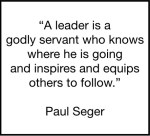
Untitled.001Paul Seger, executive director of Biblical Ministries Worldwide, offers an excellent definition of a godly leader when he writes, “A leader is a godly servant who knows where he is going and inspires and equips others to follow.” In truth, all men should aspire to grow in godliness by the grace of God. All men should be praying for opportunities to exercise servant-like leadership at some level. Today the biblically defined roles of deacon and elder seem more often ignored or misunderstood than embraced and elevated. Every local church needs men who provide logistical services and men who focus on the ministry of the Word of God and prayer.

One of the earliest examples of men being carefully chosen to fulfill a ministry of service and assistance is found in Acts 6

And the twelve summoned the full number of the disciples and said, “It is not right that we should give up preaching the word of God to serve tables. Therefore, brothers, pick out from among you seven men of good repute, full of the Spirit and of wisdom, whom we will appoint to this duty. But we will devote ourselves to prayer and to the ministry of the word.” v2-4

These servants were specifically selected in order to do whatever was needed to free the apostles so that they could fulfill their responsibility of shepherding and teaching the church. After the Apostles, the Lord has specifically given “evangelists” and “shepherd-teachers” (see Eph 4:11) whom He has charged with teaching, praying, and leading His Church in all spiritual matters.

Shepherding is a wonderful picture found throughout Scriptures of the one who is charged with caring for the spiritual needs of a local congregation. The Apostle Peter exhorted elders to “shepherd the flock of God that is among you, exercising oversight,” and goes on to charge the elders to “be examples to the flock” (see 1 Peter 5:1, 2, 3).

In Acts 20:28 the Apostle Paul said, “Pay careful attention to yourselves and to all the flock, in which the Holy Spirit has made you overseers, to care for the church of God, which he obtained with his own blood.” The shepherd is commanded to keep an eye on his own spiritual well-being and those whom he is charged to lead and feed; those whom Christ purchased with “his own blood.”

The genuine affection of a shepherd is inseparably connected to his ability to “teach.” Using the picture of a shepherd tending his flock, he must “feed the sheep.” If the sheep are malnourished, fed rotten food, or allowed to become dehydrated they will become weak, sickly, susceptible to disease, or dead. A godly leader is a good follower of Christ. He is a disciple who loves, leads, serves, and feeds the sheep in the local church.

12046664_1094907980521449_5680740681765925352_n

Yes – It is a shame that godly leaders do not simply grow on trees. Thabiti M. Anyabwile said, “Without godly, faithful, replicating leadership, churches suffer deeply.” And yet by God’s grace godly leaders can grow in every church that is committed to the Scriptures and praying for the Lord to bless His Church.

Local church leadership is a high and holy responsibility to be taken seriously and exercised faithfully for the good of the people and the glory of the Lord. If we, therefore, do not hear or do not heed His instruction we are either ignorant of the Scriptures or self-deceived into thinking that we can do a better job on our own. Any church that finds itself in a place where God’s Word is not the highest authority for its leadership is a very unhealthy church.


Excellent Leadership Resources:

Finding Faithful Elders and Deacons Thabiti M. Anyabwile

Selecting Elders: A Biblical Guide to Choosing God’s Shepherds Dave Deets

Sticky Teams Larry Osborne

Agape Leadership: Lessons in Spiritual Leadership From the Life of R. C. Chapman Robert Peterson & Alexander Strauch

Chief: Leadership Lessons from a Village in Africa Paul Seger


A Box of Chocolates

7098_dtEvery year around the holidays my grandmother would purchase Russell Stover boxes of assorted chocolates.  Lots of them.  (Wow, just thinking about this makes my mouth water.)  Anyway, she always had the chocolates out for family and friends who happened to stop by for a visit.

Motivated, of course, to help my grandmother resist these tiny temptations I would eat as many as possible on every visit.  I had actually become so familiar with these delightful sweets that I could identify them by color, shape, swirl, or just looking at the edges.  Of course the very best way to identify them was to  gently press your finger into the bottom of each one.

Those chocolates were amazing!  (I had to beat my sister to the box in order to get the good ones.)  Some of them had soft creamy centers and some had hard candy centers.  Some had peanut butter, some had caramel, and some had toffee.  Some of them even had peanuts, almonds, or walnuts in the center.

Now let’s be honest here. That pretty well describes any local church family.  Some people are hard, some people are soft, and some people are just nuts covered in chocolate!

One of the key strengths of the Church is that we are not all identical.  Why do I say strength?  Because the watching world looks at this local group of drastically different individuals and marvels at our unity and the deep affection we have for one another (see John 13:34-35; 1 Corinthians 12:12-27; Ephesians 4).

How is this unity amidst such diversity possible?  It is only possibly through the blood of Jesus Christ.  The Apostle Paul said, “For in Him [Jesus Christ] all the fullness of God was pleased to dwell, and through Him to reconcile to himself all things, whether on earth or in heaven, making peace by the blood of his cross” (Colossians 1:19-20).

Through the precious blood of Jesus Christ we now share the same heavenly Father (John 1:12-13), the same Holy Spirit (1 Corinthians 12:13), the same Body (the Church; Ephesians 1:22-23), the same heavenly Destiny (Revelation 21:1–4), and we share the same holy Calling (1 Peter 1:16)!

  • Do you know God’s peace? Romans 3:10-23; 5:8; 6:10-11, 23; 10:9-10, 13
  • If you DO know God’s peace: Romans 12:18; Romans 14:19; 2 Corinthians 13:11; Ephesians 4:3; Colossians 3:15; James 3:18

My prayer for Ukraine…

A week after 9/11 (2001) a small group of us spent two weeks in Kiev and Odessa Ukraine with Slavic Gospel Association.  It was… incredible.  (Though no-one prepared me for being greeted with “a holy kiss”…over and over and over…everywhere we went.)

The pastors we met were dedicated (and godly) men who love the Word, cherish the Son, exalt the Father and yearn for their friends and neighbors to come to Christ.  Whole communities came out for the 3-4 hour long services that often included 2-4 sermons.  People arrived early, quietly prepared their hearts before the service and tearfully sang with rapturous joy in their hearts.

We also visited orphanages full of children.  I will never forget the little boy Uri who approached me and in broken but clear English said, “My name is U-ri. Vhat is yours?”  I wish someone could have taken a picture of his expression when I said, “Clegguart” (pronounced clay-gert) … I was ready to adopt him on the spot (along with the rest of the children).

I often find myself praying for the pastors we met and the churches in which we ministered.  One in particular stands out in my mind. Outside of Odessa and down rough dirt roads (I’m being generous) and across several fields lay a tiny little village where church was held every week, in a garage.

Packed in like sardines and using a little Casio keyboard for accompaniment, we gathered for worship.  After the service we walked a short distance down the road to a pile of rocks (not finely crafted bricks – random rocks).  The enthusiasm and anticipation was almost unbelievable.  This was to be their new church building.  They were building, stone by stone, piece by piece, mostly with their bare hands, a church.

I don’t know the political ups and downs of the current situation in Ukraine.  I do know that God is still on His throne and the Gospel still saves.

My prayer for Ukraine: May God’s people be faithful, God’s Word be proclaimed, God’s Spirit be unleashed, God’s Son be exalted and God be glorified!

To my pastor friends in Ukraine… Remember: Preach the Word, love the people and trust the Lord!

Image

Praying for Pastors tonight…

pulpit_frontPraying tonight for those men who stand in the pulpit to give faithful exposition of the word of God… most of us will spend our lives in earthly anonymity.

That’s OK!

Tomorrow is Sunday. The Lord’s Day. The gathering of the brethren in order to feed on the word, to hear from the Lord, and to commune with one another. Most important of all they will gather in order to engage the heart, ready the mind, and prostrate the soul in worship of the living God.

Brothers: Preach so as to please God, not men!

“Behold, I send you out as sheep in the midst of wolves; therefore be shrewd as serpents, and innocent as doves.” (Matt. 10:16)

“I charge you in the presence of God and of Christ Jesus, who is to judge the living and the dead, and by his appearing and his kingdom: preach the word; be ready in season and out of season; reprove, rebuke, and exhort, with complete patience and teaching. For the time is coming when people will not endure sound teaching, but having itching ears they will accumulate for themselves teachers to suit their own passions, and will turn away from listening to the truth and wander off into myths. As for you, always be sober- minded, endure suffering, do the work of an evangelist, fulfill your ministry.” 2 Timothy 4:1-5

“This is how one should regard us, as servants of Christ and stewards of the mysteries of God. Moreover, it is required of stewards that they be found faithful.” 1 Corinthians 4:1-2

Additional Food For Thought:

Isaiah 6:1-8; 2 Timothy 2:1-7; 15; Revelation 4:10-11; 5:8-10; 7:11