You Need God Today

Christian, if you are not reading God’s Word each day in order to commune with God, then you are not living the Christian life from day to day.

This is not a call to religious box-checking.

Reading the Bible every day does not earn favor with God. The issue is much more fundamental than that.

The Christian life is a life lived in fellowship with God.

Jesus told His disciples:

“Abide in me, and I in you.” – John 15.4

And just a few verses later:

“If you abide in me, and my words abide in you…” – John 15.7

Christianity is not merely believing the right things about God and then going about our lives. We have been brought into a relationship with Him. We are called to walk with Him, depend upon Him, listen to Him, trust Him, and increasingly have our lives shaped by Him.

That means Bible reading is about much more than information. You can read three chapters every morning, study difficult passages, know a great deal about the Bible, and still fail to come to the Scriptures to commune with God.

Yes, God has given us His Word. But the goal isn’t simply to get God’s Word into your schedule.

The goal is to get God’s Word into you.

To hear what God has said. To have your thinking corrected, your desires exposed, your fears confronted, and your priorities reordered. To be reminded again of what is true about God, about yourself, about this world, and about the life He has called you to live.

That is why yesterday isn’t enough.

Yesterday you needed God’s truth. Today you need it again. Yesterday your mind needed to be renewed. Today it does too. Yesterday you needed your heart redirected away from yourself and toward God. You will need that again today.

You cannot live today’s Christian life on yesterday’s communion with God.

This is not about guilt. It is about need.

The God who created you has spoken. The God who saved you has made Himself known. And He has graciously given you His Word so that you might know Him, believe Him, obey Him, delight in Him, and walk with Him.

So, Christian, open your Bible today.

Not merely because Christians are supposed to read their Bibles. Not so you can check another box. Not so you can feel better about yourself.

Open it because you need God today.

Don’t Miss a Day

My phone really doesn’t want me to miss a day.

Apps congratulate us for opening them several days in a row. Games reward us for coming back tomorrow. Fitness and weight-management apps keep track of our consecutive days. Miss one, and the counter may start over.

They’re called streaks, and there is a reason they work. They help form habits. They give us a small sense of accomplishment. And, of course, they keep us coming back to the app. None of that is necessarily bad.

But I wonder if all this streak-building is also training us to think that consistency is the same thing as relationship.

It isn’t. And that matters when we open our Bibles.

A streak can tell you whether you did something. It cannot tell you why you did it – or what happened while you were there.

You can read your Bible every morning. You can complete the assigned chapters. You can check the box. You can watch the number on your Bible app climb from 30 days to 100 days to 365 days. And you can do all of that without really communing with God.

God warned His people through Isaiah:

“This people draw near with their mouth
and honor me with their lips,
while their hearts are far from me.”
– Isaiah 29.13

The problem wasn’t that they were doing nothing religious. They were. The problem was that their outward activity had become disconnected from their hearts.

That danger hasn’t disappeared. We can become very disciplined at doing Christian things without paying much attention to the God those things are supposed to draw us toward.

That doesn’t make habits bad. Discipline matters. There will be mornings when discipline gets you out of bed and into the Word when you don’t particularly feel like doing it. There is something good about developing habits that regularly put us in places where our hearts can be shaped by God’s truth.

But the habit is not the goal. 

God is.

Imagine measuring your closest relationships by streaks. Talked to my wife today. Another day completed. Streak intact.

Something about that immediately feels wrong. I don’t want merely to maintain contact with my wife. 

I want to know her. Listen to her. Talk with her. Share life with her. A relationship is more than repeated interaction.

When we open the Bible, there is a Person there whom we are seeking to know. God has spoken.

So the question isn’t simply, Did I read my Bible today There are better questions:

Did I listen? 

Did I believe what God said? 

Did I allow His Word to correct my thinking? 

Did I submit myself to what He said? 

Did I come to Scripture because I wanted to know Him – or merely because I didn’t want to miss a day?

Don’t confuse consistency with communion.

Keep the habit. Build the discipline. Read your Bible every day. But don’t settle for the streak.

Don’t open your Bible tomorrow merely because you opened it today.

Open it because there is a God you need to know, hear, trust, and walk with.

When Knowing Isn’t Enough

Forked paths lead toward churches beneath sunrise and moonlight, with book and anchor

There is a version of Christianity that can look remarkably faithful from a distance.

You know what Christians are supposed to believe. You know what Christians are supposed to reject. You avoid the bad things. You affirm the good things. You know which boxes to check.

And yet, you can do all of that without developing much wisdom for actually living as a Christian.

That becomes a problem because most of life does not arrive in neatly labeled boxes.

The difficult coworker isn’t a theological proposition. Neither is the neighbor whose life looks completely different from yours. Neither is deciding what to do with your money… responding when someone wounds you… navigating a difficult cultural question… raising children… handling disagreement… or knowing when to speak and when to remain silent… or so much more.

Those things require more than knowing which answers are Christian.

They require discernment.

That is something Paul specifically prayed believers would develop:

“And it is my prayer that your love may abound more and more, with knowledge and all discernment, so that you may approve what is excellent.” – Philippians 1.9-10

Notice the connection: love, knowledge, and discernment.
Paul wanted believers who knew the truth – and who were increasingly able to recognize what faithfulness to that truth looked like in the complexities of actual life.

Because biblical truth is meant to give us a way of seeing the whole world.

Scripture teaches us who God is, who we are, what has gone wrong with this world, what God values, what sin does to us, what people desperately need, and what ultimately matters.

And then we have to learn to live accordingly.

Without that kind of discernment, Christians can drift toward two very different extremes.

Some are seduced by the world.

They may know biblical truth, but they have never learned to think biblically about the world around them. So when complicated questions arise, the world supplies the categories. Its assumptions gradually become their assumptions. Its definitions of success, happiness, identity, sexuality, money, freedom, and the good life begin to feel perfectly reasonable.

Others become cocooned from the world.

They preserve their Christian answers by keeping everything complicated safely outside. They know what they oppose. They know what they don’t watch. They know where they don’t go. They know which people are wrong.

Their convictions may remain intact. But those convictions increasingly have little contact with anyone or anything outside the cocoon.

Neither is Christian discernment.

Discernment asks a harder question:
* What does faithfulness to God look like right here?
* Not merely, What am I supposed to believe about this?
* But how should what I believe change how I respond?
* How does the gospel shape the way I treat this person?
* What does obedience to God require of me in this decision?
* What desires are driving me?
* What assumptions have I accepted without examining them?
* How can I demonstrate both truth and love here?

That is very different from checking boxes.

We desperately need Christians whose minds are so saturated with Scripture that they can recognize the world’s lies without being terrified of the world.

Christians whose convictions are strong enough to resist cultural pressure, but whose love is strong enough to move toward people rather than away from them.

Christians who don’t merely know what the Bible says, but are learning how God’s truth bears upon conversations, relationships, decisions, disappointments, opportunities, temptations, and ordinary responsibilities.

So perhaps the question isn’t simply: Do I believe the right things?

We should.

But there is another question worth asking: Am I learning to live wisely because I believe them?

But I Had a Reason

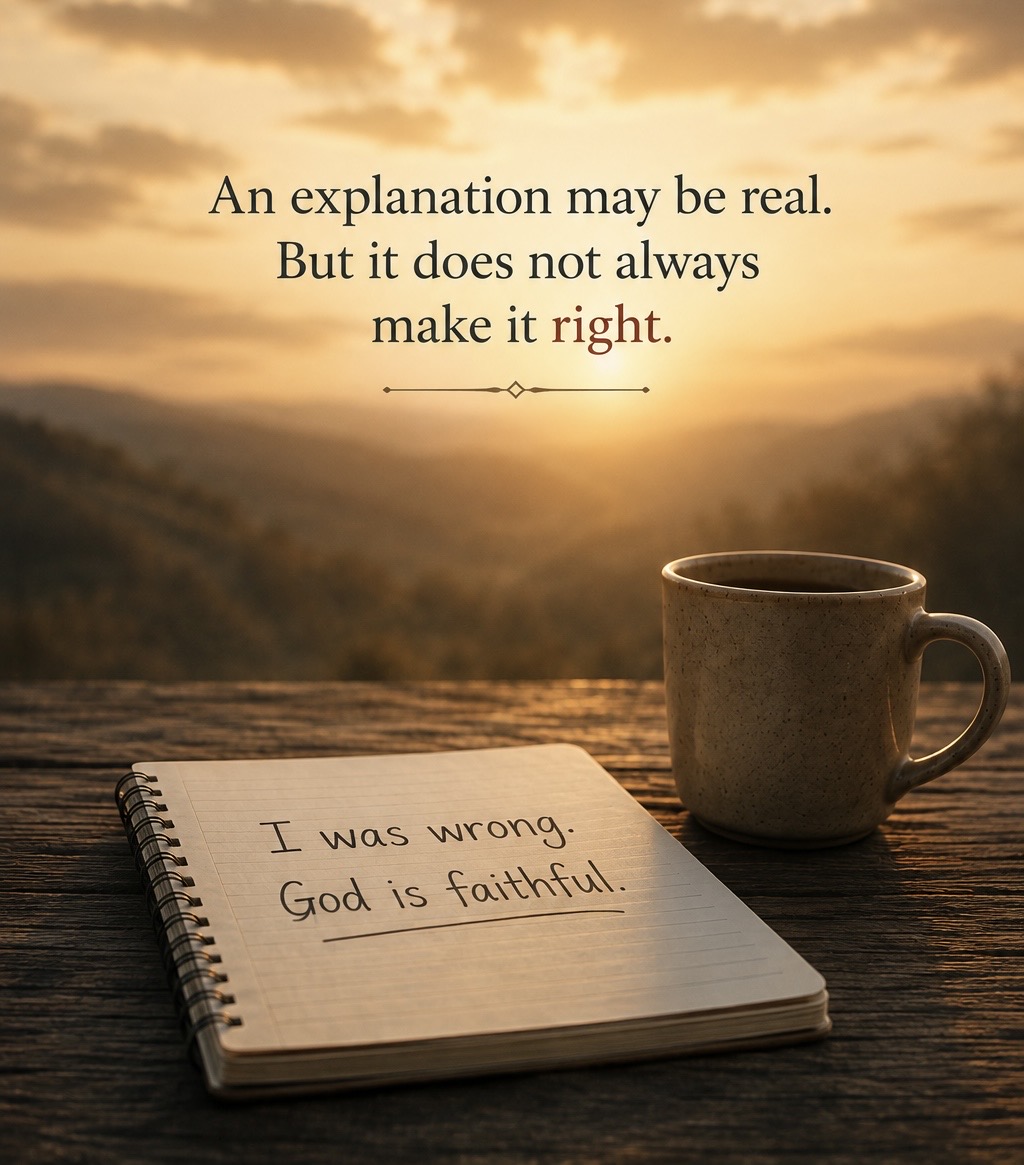
We almost always have a reason.

A reason we became angry.
A reason we said what we said.
A reason we weren’t completely honest.
A reason we treated someone poorly.
A reason we refused to forgive.
A reason we did what we knew we probably shouldn’t do.

And sometimes our reasons are pretty good ones.
We were tired.
We were afraid.
We had been hurt.
Someone betrayed us.
We were under tremendous pressure.
We didn’t know what else to do.

The circumstances may be real. The hurt may be real. The pressure may be real.
But having a reason for doing something does not necessarily make what we did right.

There is an important difference between an explanation and a justification.

An explanation answers the question: Why did I do this?

A justification answers a very different question: Was I right to do it?

And those are not the same thing.

Scripture is filled with people who had reasons for what they did. Adam blamed the woman God had given him. Eve pointed to the serpent. Aaron had an explanation for the golden calf.

Saul had a reason for keeping what God had commanded him to destroy. He even made his disobedience sound spiritual. The animals, he explained, had been spared so they could be sacrificed to the Lord.
Samuel’s response was simple: “Behold, to obey is better than sacrifice.” – 1 Samuel 15.22

Saul had a reason. But his reason didn’t make his disobedience obedience.
And perhaps that is where we sometimes get ourselves into trouble.

We begin to believe that if our circumstances are difficult enough, our hurt deep enough, or our reasoning understandable enough, then what would normally be wrong becomes right. But our circumstances do not have the authority to rewrite what God has said.

That doesn’t mean circumstances don’t matter.

They can help us understand why someone did what they did. They can move us toward compassion. They can help us recognize the pressures, fears, wounds, or desires that contributed to a decision.

But circumstances do not define righteousness. God does. And before we apply that truth to someone else’s choices, we should probably apply it to our own.

I may have been tired.
I may have been frustrated.
I may have been treated unfairly.
I may have been deeply hurt.
I may even have a perfectly understandable reason for what I did. But if God says it was wrong, my reason cannot make it right.

Perhaps that is why one of the most difficult sentences for us to say is also one of the simplest: I was wrong.

No explanation.
No qualification.
No – “but you have to understand.”

Just confession.

And thankfully, Christians do not have to justify what God has already offered to forgive.

“If we confess our sins, he is faithful and just to forgive us our sins and to cleanse us from all unrighteousness.” – 1 John 1.9

There may be reasons for what we have done. But God has not asked us to justify our sin. He has invited us to confess it.

Come Away and Rest Awhile

There is almost always something else that could be done.

Another email could be answered. Another project could be finished. Another room could be cleaned. Another phone call could be made. Another problem could be solved.

And if we aren’t careful, we can begin to live as though stopping is irresponsible.

After all, Scripture has a great deal to say about hard work. God does not commend laziness. We are called to diligence, faithfulness, and making good use of the time He gives us. There is something good about going to bed tired after a day spent doing what God has given us to do.

But apparently faithfulness also includes knowing when to stop.

After a particularly busy season of ministry, Jesus said to His disciples, “Come away by yourselves to a desolate place and rest a while.” – Mark 6.31

What makes those words especially striking is what Mark tells us next: “For many were coming and going, and they had no leisure even to eat.” There were people everywhere. There were needs to be met. There was ministry to be done. And Jesus said, Come away and rest. That is worth thinking about.

Sometimes we imagine that rest is what we do when everything else is finished. We will slow down when the project is completed. We will take some time off when things settle down. We will rest when there is nothing pressing that needs our attention.

The problem is that everything is rarely finished. There will always be something more we could do. Which means that if we only permit ourselves to rest when there is nothing left to do, we may never really rest at all.

Perhaps learning to rest is also learning to trust.

There is a kind of humility in stopping. When I stop working, I am reminded that I am not indispensable. I have limits. I get tired. I need sleep. I need quiet. I need time away. God made me that way. And while I rest, God does not.

The psalmist says, “He who keeps Israel will neither slumber nor sleep” (Psalm 121.4). What a comforting distinction. I need rest. God does not.

The world does not depend upon my constant activity. My family does not ultimately depend upon me. My church does not ultimately depend upon me. My work does not ultimately depend upon me. Everything ultimately depends upon Him.

That doesn’t make me less diligent. It frees me to work hard when it is time to work – and to rest without guilt when it is time to rest.

Of course, there are seasons that require unusual effort. There are late nights and early mornings. There are emergencies and deadlines. There are babies who don’t sleep, people who need us, unexpected problems, and responsibilities that cannot simply be postponed.

Sometimes faithfulness really does require us to keep going when we would rather stop. But those seasons should also remind us why rhythms of rest matter.

We were never designed for constant activity. And sometimes our refusal to stop may say less about our diligence than we think. It may reveal how difficult it is for us to believe that things can continue without us.

Rest reminds us that we are creatures – and God is God.

So sometimes the godly thing to do really is to take the afternoon off. To go for a walk. To sit somewhere quiet. To take the vacation. Maybe even to take the nap. Not because our responsibilities don’t matter. Not because diligence is unimportant. But because we trust the One who remains at work when we are not.

Jesus looked at tired disciples surrounded by unfinished ministry and unmet needs and said, “Come away…and rest a while.”

Maybe some of us need to hear Him say that again.

Guarding the Unity of the Church

“…eager to maintain the unity of the Spirit in the bond of peace.” – Ephesians 4:3

People leave churches for different reasons. Sometimes that happens in a healthy and God-honoring way. At other times, it does not. Most of the time, people do not leave all at once. They drift. Little by little, influences and opportunities begin to pull them away from the life and unity of the church.

Scripture calls us to think carefully about the nature of the church. God has not designed His people to live in isolation, nor to create parallel or competing expressions of church life. He gathers His people into visible, accountable communities that are shepherded by recognized leaders, shaped by His Word, and marked by unity.

Because of that, we should be thoughtful when invitations or opportunities arise, especially those that exist outside the life and accountability of a local church, or that begin to function as a parallel influence on our direction, doctrine, or spiritual growth. This can take many forms: independent gatherings, loosely connected Bible studies, online voices that begin to shape our thinking, or groups that function without clear shepherding or accountability.

Not every invitation is helpful. And not every gathering is wise to join.

Wisdom asks simple questions:
– Is this drawing me closer to the life of my church, or subtly away from it?
– Is this reinforcing the teaching and leadership God has placed over me or competing with it?
– Is this strengthening unity or introducing confusion?


Christ loves His church. He gave Himself for her. And the unity He creates is not maintained by accident, it is guarded through conviction, clarity, and a faithful commitment to the church He died for.

Guard the unity Christ has given by remaining faithfully committed to a biblical church, and by being wise and careful when that commitment is challenged or changed.