When a Sermon Rubs You the Wrong Way

Have you ever heard a sermon that rubbed you the wrong way?

Maybe something the preacher said bothered you. Maybe you disagreed with the way he said it. Maybe you walked away thinking he was too harsh, too strong, or simply wrong.
I have.

And sometimes, after thinking about it, I have concluded that I really did disagree. Preachers are not infallible. We can misunderstand a passage, say something poorly, or fail to explain something as carefully as we should.

But sometimes the problem was not the sermon. Sometimes the truth had simply gotten too close. And that is much harder to admit.

When a sermon makes us uncomfortable, it is remarkably easy to begin framing our understanding of the sermon around our feelings.
I felt attacked.
– That sounded unkind.
– I did not like the way he said what he said.

And before long, our reaction to the sermon becomes our interpretation of the sermon.

But feeling uncomfortable does not necessarily mean we have been treated unfairly. Sometimes conviction is uncomfortable. Sometimes correction is uncomfortable. Sometimes the Word of God confronts something in us that we would rather defend than examine.

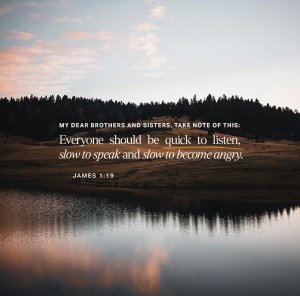
James writes: “Let every person be quick to hear, slow to speak, slow to anger.” – James 1.19

We often use those words as general advice for relationships and communication, and rightly so. But James is writing about our response to the Word of God. A few verses later, he tells us to “receive with meekness the implanted word.”

Perhaps we need to learn to listen to expositional preaching with expositional hearing.

That means we do not begin with, “How did that make me feel?”
We begin with:
– What did the preacher actually say?
– What was he trying to communicate?
– What does the text actually say?
– And why did this bother me so much?
We would do well to listen prayerfully before reacting quickly.

That does not mean every preacher is right. It does not mean we accept everything we hear without discernment. We should open our Bibles. We should examine the text. We should test what is taught.

But biblical discernment and personal defensiveness are not the same thing.
One wants to know whether the message is true.
The other wants to prove that my reaction was justified.

How we respond when the Word confronts us may reveal more about our hearts than we realize.
– Pride is quick to speak, quick to defend, and quick to assume the problem lies somewhere else.
– Humility is willing to listen again. Humility opens the Bible. Humility prays, “Lord, show me what is true, even if I do not like what I find.”

The next time a sermon rubs you the wrong way, do not be too quick to dismiss it. Listen to it again. Open your Bible. Pray. And ask whether the truth that unsettled you might be the truth you needed to hear.

Got Issues?

no whiningIt just so happens that I was standing in the perfect position to overhear myself talking the other day.  What I heard was shocking!  I still can’t believe it.  It sounded just like, gulp, whining!  Whining?  Me?  Whining? Yes.  What’s worse I was whining about something from a situation so long ago, I’m certain few if any of the people involved would even remember it.  Incredibly I discovered myself indulging in our modern self-justifying rabble of: “You must excuse my current sour attitude.  My personal issues provide me with a much needed pass on responsibility.”

Is this not the attitude that so many people have today?  We find it easy to complain, easy to express self-pity, easy to self-justify.  So many people today see their life as full of loss, hurt, or betrayal that they honestly believe they have the right to whine.  Like some kind of spiritual entitlement that says, “You don’t get to hold me accountable because someone hurt me.”  It’s amazing how many people are held prisoner by the memory of those who may (or may not) have sinned against them.  What’s more incredible are how many people who sincerely believe that their issue(s) free them from fulfilling basic personal duties.

It should be no surprise that the antidote for our narcissistic sour-grapes is not personal therapy.  What is needed most is sound Theology.  Seriously, what makes more sense to you, focusing time and attention on you and your own “issues”?  Or concentrating on something, Someone, who is Himself far greater than you?  I would like to take this opportunity to share with you the single most theologically sound reasoning that I can offer.  Whether you have experienced mom-issues, dad-issues, sibling issues, financial issues, abuse issues, neglect issues, whatever your issues, past or even present.  The single most theologically sound response I can muster is this:  So what?  Get in line.

My lovely wife and I have seven wonderful little children.  We would not trade any of them for anything in the world.  I’ve seen firsthand that each one of our children, adorable as they are, was born just like every other human being on the planet.  They are selfish, mean, depraved little sinners.  My point is this: people do dumb things because people are sinners.  It’s in their very nature to do dumb.  Whenever we do dumb things, others are affected and others feel the impact of our sin.  In other words, you and I can cause others to have personal “issues” as well.  (If you are uncertain at this point, just ask your wife or your kids.)

What we need most is a good healthy dose of humility.  You are a sinner.  I am a sinner.  Was it not for the grace of God we would be utterly consumed with our own selfish desires and eagerly satisfying our fleshly lusts.  And every time we do that, other people feel the devastating effects.  Remember Achan?

Let’s be brutally honest here, it is time for Christian people to realize that there is no place for a victim mentality in the church.  Our circumstances, however hard they may be, do not compare to the cross of our Lord Jesus Christ and the wrath He bore there.  The cross of Christ forever stands at the center of all things crying out: “We are all guilty.”  “We are all bad people.”  “Get over yourself.”  “You can do nothing to improve you or others.”  But “God, in Christ, can!”

Remember friends, it is the preaching of the cross that is the power of God (1 Corinthians 1:18).  When your emotions need to be reminded of what you know is true – preach the Gospel to your own heart!  Don’t allow your heart to feed the Me-Monster.  Don’t listen to the wisdom of the world (which is foolishness).  Unleash the power of God in your own life.  Like David remind your emotions of what you know is true (Psalm 27).  Get over yourself and confess with Paul, “For I am persuaded, that neither death, nor life, nor angels, nor principalities, nor powers, nor things present, nor things to come, Nor height, nor depth, nor any other creature, (or issue, or church member, or whatever) shall be able to separate us from the love of God, which is in Christ Jesus our Lord” (Romans 8:38-39 italics added).

(Originally published in a recent edition of IFCA NEWS)