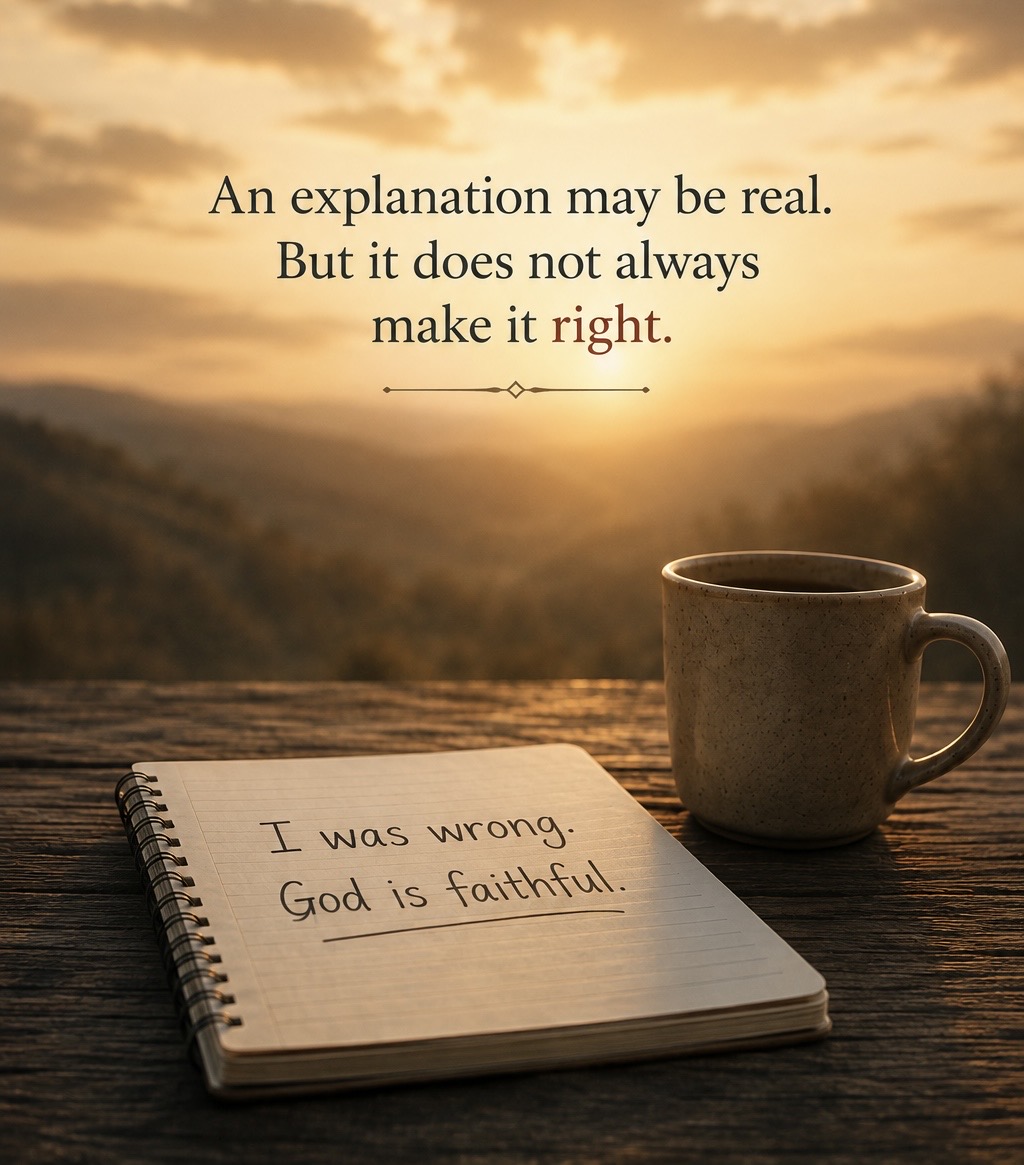
We almost always have a reason.
A reason we became angry.
A reason we said what we said.
A reason we weren’t completely honest.
A reason we treated someone poorly.
A reason we refused to forgive.
A reason we did what we knew we probably shouldn’t do.
And sometimes our reasons are pretty good ones.
We were tired.
We were afraid.
We had been hurt.
Someone betrayed us.
We were under tremendous pressure.
We didn’t know what else to do.
The circumstances may be real. The hurt may be real. The pressure may be real.
But having a reason for doing something does not necessarily make what we did right.
There is an important difference between an explanation and a justification.
An explanation answers the question: Why did I do this?
A justification answers a very different question: Was I right to do it?
And those are not the same thing.
Scripture is filled with people who had reasons for what they did. Adam blamed the woman God had given him. Eve pointed to the serpent. Aaron had an explanation for the golden calf.
Saul had a reason for keeping what God had commanded him to destroy. He even made his disobedience sound spiritual. The animals, he explained, had been spared so they could be sacrificed to the Lord.
Samuel’s response was simple: “Behold, to obey is better than sacrifice.” – 1 Samuel 15.22
Saul had a reason. But his reason didn’t make his disobedience obedience.
And perhaps that is where we sometimes get ourselves into trouble.
We begin to believe that if our circumstances are difficult enough, our hurt deep enough, or our reasoning understandable enough, then what would normally be wrong becomes right. But our circumstances do not have the authority to rewrite what God has said.
That doesn’t mean circumstances don’t matter.
They can help us understand why someone did what they did. They can move us toward compassion. They can help us recognize the pressures, fears, wounds, or desires that contributed to a decision.
But circumstances do not define righteousness. God does. And before we apply that truth to someone else’s choices, we should probably apply it to our own.
I may have been tired.
I may have been frustrated.
I may have been treated unfairly.
I may have been deeply hurt.
I may even have a perfectly understandable reason for what I did. But if God says it was wrong, my reason cannot make it right.
Perhaps that is why one of the most difficult sentences for us to say is also one of the simplest: I was wrong.
No explanation.
No qualification.
No – “but you have to understand.”
Just confession.
And thankfully, Christians do not have to justify what God has already offered to forgive.
“If we confess our sins, he is faithful and just to forgive us our sins and to cleanse us from all unrighteousness.” – 1 John 1.9
There may be reasons for what we have done. But God has not asked us to justify our sin. He has invited us to confess it.

