Grace assumes the best; pride suspects the worst.

Pride is remarkably confident about other people’s motives.

“He did that because…”

“She only said that because…”

“I know what they’re really trying to do…”

But most of the time, we don’t know.

Grace does not ignore sin or pretend that evil is good. But neither does it manufacture motives, presume guilt, or fill gaps in our knowledge with suspicion.

Grace asks before accusing.

Grace leaves room for explanation.

Grace is willing to believe the best that the facts will allow.

And when something truly is wrong, grace grieves rather than delights in having its suspicions confirmed.

Love does not require us to ignore sin.

It does require us to stop inventing it.

“Love… is not resentful… bears all things, believes all things, hopes all things, endures all things.” – 1 Corinthians 13.5, 7

But I Had a Reason

We almost always have a reason.

A reason we became angry.
A reason we said what we said.
A reason we weren’t completely honest.
A reason we treated someone poorly.
A reason we refused to forgive.
A reason we did what we knew we probably shouldn’t do.

And sometimes our reasons are pretty good ones.
We were tired.
We were afraid.
We had been hurt.
Someone betrayed us.
We were under tremendous pressure.
We didn’t know what else to do.

The circumstances may be real. The hurt may be real. The pressure may be real.
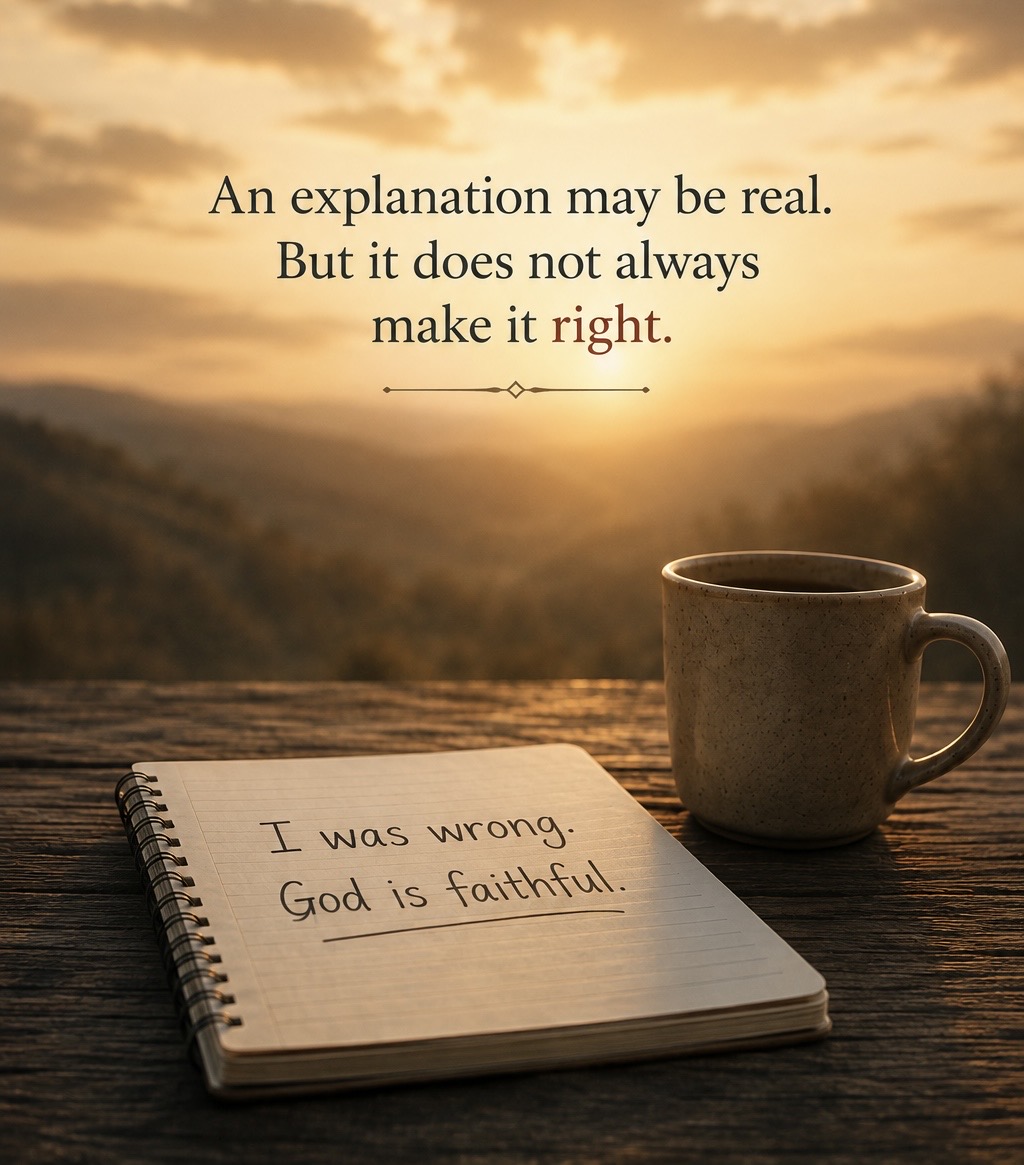
But having a reason for doing something does not necessarily make what we did right.

There is an important difference between an explanation and a justification.

An explanation answers the question: Why did I do this?

A justification answers a very different question: Was I right to do it?

And those are not the same thing.

Scripture is filled with people who had reasons for what they did. Adam blamed the woman God had given him. Eve pointed to the serpent. Aaron had an explanation for the golden calf.

Saul had a reason for keeping what God had commanded him to destroy. He even made his disobedience sound spiritual. The animals, he explained, had been spared so they could be sacrificed to the Lord.
Samuel’s response was simple: “Behold, to obey is better than sacrifice.” – 1 Samuel 15.22

Saul had a reason. But his reason didn’t make his disobedience obedience.
And perhaps that is where we sometimes get ourselves into trouble.

We begin to believe that if our circumstances are difficult enough, our hurt deep enough, or our reasoning understandable enough, then what would normally be wrong becomes right. But our circumstances do not have the authority to rewrite what God has said.

That doesn’t mean circumstances don’t matter.

They can help us understand why someone did what they did. They can move us toward compassion. They can help us recognize the pressures, fears, wounds, or desires that contributed to a decision.

But circumstances do not define righteousness. God does. And before we apply that truth to someone else’s choices, we should probably apply it to our own.

I may have been tired.
I may have been frustrated.
I may have been treated unfairly.
I may have been deeply hurt.
I may even have a perfectly understandable reason for what I did. But if God says it was wrong, my reason cannot make it right.

Perhaps that is why one of the most difficult sentences for us to say is also one of the simplest: I was wrong.

No explanation.
No qualification.
No – “but you have to understand.”

Just confession.

And thankfully, Christians do not have to justify what God has already offered to forgive.

“If we confess our sins, he is faithful and just to forgive us our sins and to cleanse us from all unrighteousness.” – 1 John 1.9

There may be reasons for what we have done. But God has not asked us to justify our sin. He has invited us to confess it.

Come Away and Rest Awhile

There is almost always something else that could be done.

Another email could be answered. Another project could be finished. Another room could be cleaned. Another phone call could be made. Another problem could be solved.

And if we aren’t careful, we can begin to live as though stopping is irresponsible.

After all, Scripture has a great deal to say about hard work. God does not commend laziness. We are called to diligence, faithfulness, and making good use of the time He gives us. There is something good about going to bed tired after a day spent doing what God has given us to do.

But apparently faithfulness also includes knowing when to stop.

After a particularly busy season of ministry, Jesus said to His disciples, “Come away by yourselves to a desolate place and rest a while.” – Mark 6.31

What makes those words especially striking is what Mark tells us next: “For many were coming and going, and they had no leisure even to eat.” There were people everywhere. There were needs to be met. There was ministry to be done. And Jesus said, Come away and rest. That is worth thinking about.

Sometimes we imagine that rest is what we do when everything else is finished. We will slow down when the project is completed. We will take some time off when things settle down. We will rest when there is nothing pressing that needs our attention.

The problem is that everything is rarely finished. There will always be something more we could do. Which means that if we only permit ourselves to rest when there is nothing left to do, we may never really rest at all.

Perhaps learning to rest is also learning to trust.

There is a kind of humility in stopping. When I stop working, I am reminded that I am not indispensable. I have limits. I get tired. I need sleep. I need quiet. I need time away. God made me that way. And while I rest, God does not.

The psalmist says, “He who keeps Israel will neither slumber nor sleep” (Psalm 121.4). What a comforting distinction. I need rest. God does not.

The world does not depend upon my constant activity. My family does not ultimately depend upon me. My church does not ultimately depend upon me. My work does not ultimately depend upon me. Everything ultimately depends upon Him.

That doesn’t make me less diligent. It frees me to work hard when it is time to work – and to rest without guilt when it is time to rest.

Of course, there are seasons that require unusual effort. There are late nights and early mornings. There are emergencies and deadlines. There are babies who don’t sleep, people who need us, unexpected problems, and responsibilities that cannot simply be postponed.

Sometimes faithfulness really does require us to keep going when we would rather stop. But those seasons should also remind us why rhythms of rest matter.

We were never designed for constant activity. And sometimes our refusal to stop may say less about our diligence than we think. It may reveal how difficult it is for us to believe that things can continue without us.

Rest reminds us that we are creatures – and God is God.

So sometimes the godly thing to do really is to take the afternoon off. To go for a walk. To sit somewhere quiet. To take the vacation. Maybe even to take the nap. Not because our responsibilities don’t matter. Not because diligence is unimportant. But because we trust the One who remains at work when we are not.

Jesus looked at tired disciples surrounded by unfinished ministry and unmet needs and said, “Come away…and rest a while.”

Maybe some of us need to hear Him say that again.

Why We Sing What We Sing

Have you ever left Sunday morning worship thinking, “I just didn’t get much out of the singing today”?

Perhaps the songs weren’t familiar. Perhaps they weren’t your preferred style. Perhaps they simply didn’t resonate with you the way you hoped they would. I have.

Sometimes I’ve concluded that I simply preferred different songs. Churches don’t always make the same musical choices, and not every song will resonate with every believer in exactly the same way.

But sometimes the problem wasn’t the songs. Sometimes I just forgot what congregational singing was actually for. It’s very easy to evaluate worship by asking questions like:

Did I enjoy those songs?
– Did they move me emotionally?
– Did I connect with them?

Those aren’t unimportant questions, but perhaps they may not be the first questions.

The Apostle Paul gives us a different perspective in Colossians 3.16. He tells us that as God’s people sing, “the word of Christ” dwells richly among them. Their songs teach. They admonish. They encourage. They fill hearts and minds with truth.

That means congregational singing is doing far more than creating an emotional experience. God is using it to shape His people.

I’ve found myself increasingly grateful for faithful congregational singing. Not because every song has been my favorite, or because every arrangement has reflected my personal preferences, but because I’ve been reminded what God is doing through it.

Faithful congregational singing doesn’t simply accompany worship; it quietly helps shape the hearts of those who participate in it. Congregational singing is the weekly rehearsal of reality.

Every Sunday the church helps one another remember what the rest of the week conspires to make us forget:
God is still holy.
– Christ is still worthy.
– The gospel is still true.
– Our hope is still secure.

We are not teaching God these things. We are reminding our emotions of them.

The world spends six days pulling our attention in a thousand different directions. It quietly teaches us to measure life by our circumstances, our emotions, our successes, our disappointments, and our fears.
Then the Lord’s Day comes.

God gathers His people, and together they sing truths that gently reorient their hearts toward what is eternally true.

That also helps explain why the songs we sing matter. The question isn’t whether a song is old or new. Nor is it simply whether it is musically excellent or emotionally moving. The better question is this: Where is this song directing my attention?

Some songs primarily magnify the greatness, holiness, faithfulness, and worthiness of God. Others spend most of their time occupied with us – our feelings, our experiences, our commitments, and our responses.

To be sure, there is a proper place for singing about what God has done in our lives. Scripture itself does that often. But biblical worship has a remarkable way of lifting our eyes beyond ourselves to the One who is worthy of our praise.

The next time you gather with God’s people, don’t begin by asking, “Did I enjoy the singing?”

Rather ask: Did these songs help me see God more clearly?

Because perhaps the greatest gift of congregational singing isn’t that it simply gives expression to our hearts. It’s that, week after week, it gently teaches our hearts where they belong.